
Taxation
ITC Last Date 30 November 2026: Claim and Fix FY 2025-26
30 November 2026 is the last date to claim FY 2025-26 ITC, declare credit notes and fix GSTR-1 or GSTR-3B errors. Which return counts, QRMP, checklist.
In short
Input tax credit on invoices and debit notes of FY 2025-26 must be taken in a return filed by 30 November 2026, or by the date you file the 2025-26 annual return if that comes first (section 16(4) of the CGST Act). The same cut-off applies to declaring credit notes and to correcting GSTR-1 and GSTR-3B for that year. Monthly filers use the October 2026 GSTR-3B; for quarterly filers the last return in time is the July–September 2026 one.
- ITC on FY 2025-26 invoices and debit notes cannot be taken after 30 November 2026, or after you file the 2025-26 annual return, whichever is earlier (section 16(4)).
- Credit notes for supplies made in FY 2025-26 must be declared by the same date (section 34(2)), and since 1 October 2025 the seller's tax comes down only if the registered buyer reverses the matching ITC.
- Errors in FY 2025-26 GSTR-1 and GSTR-3B can be corrected only until the same date (sections 37(3) and 39(9)).
- Monthly filers: the October 2026 GSTR-3B, filed by 30 November, is the last return for FY 2025-26 credit. Quarterly filers claim ITC only in the quarterly GSTR-3B, and the October–December return is filed after the cut-off.
- ITC taken on bills whose supplier had not filed GSTR-3B by 30 September 2026 must be reversed in a GSTR-3B filed by 30 November 2026 (rule 37A).
The short answer
30 November 2026 is the last date for four jobs relating to financial year 2025-26 (1 April 2025 to 31 March 2026):
- Claim any input tax credit (ITC) you have not yet taken on FY 2025-26 invoices and debit notes.
- Declare credit notes for sales you made in FY 2025-26.
- Correct errors in your FY 2025-26 GSTR-1.
- Correct errors in your FY 2025-26 GSTR-3B.
Each of these closes on 30 November 2026, or on the day you file your 2025-26 annual return, if that comes first. After that, credit you missed is gone, and a credit note no longer reduces your tax.
The deadline is not “a return due by 30 November”. It is a date by which the return must actually be filed, and which return that is depends on whether you file monthly or quarterly.
What closes on 30 November 2026
| Job | Law | Cut-off for FY 2025-26 |
|---|---|---|
| Take ITC on invoices and debit notes | Section 16(4), CGST Act | 30 Nov 2026 or annual return date, whichever is earlier |
| Declare credit notes for FY 2025-26 sales | Section 34(2) | Same |
| Correct errors or omissions in GSTR-1 | Section 37(3) | Same |
| Correct errors or omissions in GSTR-3B | Section 39(9) | Same |
| Reverse ITC where the supplier had not filed GSTR-3B by 30 Sept 2026 | Rule 37A, CGST Rules | In a GSTR-3B filed by 30 Nov 2026 |
The 30 November date came in with the Finance Act 2022, in force from 1 October 2022. Before that, the cut-off was the due date of the September return.
For a debit note, the year that counts is the year of the debit note itself, not of the original invoice. The words linking it to the invoice’s year were removed from section 16(4) from 1 January 2021.
The “whichever is earlier” catch
Every one of these limits says 30 November or the date of furnishing the relevant annual return, whichever is earlier.
The annual return (GSTR-9) for FY 2025-26 is due by 31 December 2026 (rule 80). Most businesses file it in December, so 30 November is the date that bites. But if your accountant files GSTR-9 early, say on 15 November, the window for that year closes on 15 November.
So the order matters: reconcile, claim, correct, then file GSTR-9.
Which return is your last chance?
Monthly filers: the October 2026 GSTR-3B
If you file GSTR-3B every month, the October 2026 GSTR-3B is your last return for FY 2025-26 credit and corrections.
- Its due date is 20 November 2026.
- It still counts if you file it late, as long as it is filed by 30 November 2026 (the late fee applies).
- The November 2026 return is filed in December, after the cut-off. It cannot carry FY 2025-26 credit.
Your October GSTR-2B comes out in mid-November, after suppliers’ October GSTR-1 (due 11 November) and IFF (due 13 November). That is your last look at what suppliers have reported before you file.
Quarterly (QRMP) filers: the July–September 2026 return
Under QRMP, no ITC is declared in the first two months of a quarter. The GST portal’s QRMP FAQ says the ITC for the whole quarter is made available in the quarterly GSTR-2B, so it is taken in the quarterly GSTR-3B. That leaves two returns near the cut-off:
| Return | When it is filed | Can it carry FY 2025-26 ITC? |
|---|---|---|
| July–September 2026 GSTR-3B | Due 22 or 24 October 2026 (by state) | Yes, if filed by 30 November 2026 |
| October–December 2026 GSTR-3B | January 2027 | No, it is filed after 30 November 2026 |
What this means for you:
- Not yet filed July–September? File it by 30 November 2026 and include every FY 2025-26 credit you are still owed. The late fee applies, but the credit is not lost.
- Already filed it? FY 2025-26 credit that was left out cannot go into the October–December return, because that return is filed after the cut-off.
There is no separate CBIC circular for QRMP on this; the position follows from the text of section 16(4), which counts the date the credit is taken. If you have a large amount at stake, speak to your CA this week.
Credit notes: date them in October
Section 34(2) says a credit note is declared in the return for the month in which it is issued, and not later than 30 November after the year of the sale.
For a monthly filer, a credit note dated October 2026 goes into the October GSTR-1 (due 11 November). A credit note dated November 2026 belongs in the November GSTR-1, which is due on 11 December, after the cut-off. In practice, every pending FY 2025-26 credit note (goods returned, rate charged too high, a discount agreed in advance) should be dated in October 2026.
For a quarterly filer, the October–December GSTR-1 is filed in January 2027. The Invoice Furnishing Facility (IFF) for October is open until 13 November 2026 (rule 59(2)) and can carry credit notes against B2B invoices (rule 59(5)). Check with your CA whether that route works for your case.
Two more things to know:
- Since 1 October 2025, the seller’s tax comes down only if the buyer, when registered, has reversed the ITC on the credit note (where the buyer had taken it). Tell your buyer about the credit note, so they act on it before their own return.
- A credit note issued after the cut-off can still settle the account with the customer, but it does not reduce your GST. The rules are in credit note vs debit note in GST.
Correcting GSTR-1 and GSTR-3B for FY 2025-26
GSTR-1 (section 37(3)). A wrong buyer GSTIN, a B2B sale reported as B2C or a wrong rate is corrected through the amendment tables (B2BA, CDNRA and the rest); a missed invoice is reported in the current return. Either way, it has to be in a GSTR-1 filed by the cut-off, which for a monthly filer is the October GSTR-1. Until a wrong GSTIN is fixed, your buyer cannot claim that credit. The portal steps are in GSTR-1 kaise bhare.
GSTR-3B (section 39(9)). A filed GSTR-3B is not revised. An omission or wrong figure is corrected in a later return, with interest where tax was short-paid, and for FY 2025-26 that later return must be filed by the cut-off: for a monthly filer, the October GSTR-3B. Corrections that come out of scrutiny, audit or an investigation follow their own route.
Rule 37A reversal. If you took ITC on a FY 2025-26 bill and the supplier still had not filed the GSTR-3B for that period by 30 September 2026, reverse that ITC in a GSTR-3B filed by 30 November 2026. When the supplier files, you can claim it again in a later return. You can check a supplier’s return filing on the GST portal’s Search Taxpayer page.
Worked example: a monthly filer’s October clean-up
A Gujarat wholesaler, filing monthly, sits down with its accountant at the end of October 2026:
| Found in the review | Rule | Action before 30 Nov 2026 |
|---|---|---|
| January 2026 bill, GST ₹9,000, shown in January GSTR-2B but never claimed | 16(4) | Claim ₹9,000 in the October GSTR-3B |
| March 2026 bill, GST ₹3,600, not in any GSTR-2B | 16(2)(aa), 16(4) | Supplier reports it in their October GSTR-1 by 11 Nov; it appears in October GSTR-2B; claim it |
| February 2026 bill, ITC ₹1,800 taken; supplier had not filed GSTR-3B by 30 Sept | Rule 37A | Reverse ₹1,800 in the October GSTR-3B; reclaim when the supplier files |
| Goods sold in December 2025 came back; GST ₹2,700 | 34(2) | Credit note dated October, in the October GSTR-1; ask the buyer to reverse the ITC |
| August 2025 invoice reported with the buyer’s GSTIN wrong | 37(3) | Amend it (B2BA) in the October GSTR-1 |
| September 2025 GSTR-3B missed ₹4,500 of output tax | 39(9) | Add it in the October GSTR-3B and pay with interest |
The ₹9,000 was sitting in the portal all along. The ₹3,600 depends on a phone call this week. Left to December, both would be lost.
Checklist before 30 November
- Close every FY 2025-26 purchase bill in your books, with the supplier’s own invoice number and GSTIN.
- Match your purchase register with GSTR-2B, month by month, for April 2025 to March 2026. Make a list of credit you have not yet claimed. The method is in GSTR-2B reconciliation.
- Chase suppliers whose FY 2025-26 bills are missing from GSTR-2B. A monthly supplier should report them in the October GSTR-1 (due 11 November); a quarterly supplier through the October IFF (open until 13 November).
- Check supplier filing status for bills where you took credit. Reverse under rule 37A where the supplier had not filed GSTR-3B by 30 September 2026.
- Issue pending credit notes for FY 2025-26 sales, dated October 2026, and tell each buyer.
- Correct GSTR-1 errors for FY 2025-26: wrong GSTINs, B2B shown as B2C, wrong rates, missing invoices.
- Correct GSTR-3B errors for FY 2025-26 in the October return, and pay any short tax with interest.
- File the October GSTR-3B (monthly) or the July–September GSTR-3B (quarterly, if still pending) by 30 November 2026. Do not leave it to the last day.
- File GSTR-9 for 2025-26 only after all of this, by 31 December 2026.
How GSTR-1, GSTR-2B and GSTR-3B feed each other is explained in GSTR-1 vs GSTR-3B.
How VyapRise helps with the 30 November clean-up
In VyapRise, download the GSTR-2B JSON for a month from the GST portal and upload it on the GSTR-2B reconciliation screen. It lists what matched your purchase bills, what is missing from GSTR-2B, what is missing from your books, and where the amounts differ, which gives you the supplier call list for step 3.
A credit note is made from the original invoice, and it goes into the credit note table of the GSTR-1 report. Once you mark a month as filed, a later change to one of its invoices or notes is reported as an amendment (B2BA, CDNRA and so on) in the month of the change, and the invoice and credit note forms warn you when a date falls in a filed month. The GST filing desk lists the due dates, including GSTR-9, runs the portal’s checks on the GSTR-1 file before you file, and emails the period’s files to your CA.
Purchase bills, credit notes, GST reports and GSTR-2B reconciliation are on the Pro plan, part of the accounting software. VyapRise does not file returns: accepting or rejecting invoices in IMS and filing GSTR-1, GSTR-3B and GSTR-9 are done by you or your CA on the GST portal.
This guide reflects the CGST Act and Rules as of 31 October 2026. Due dates are sometimes extended by notification; confirm your own position, and any QRMP or IFF route, with your CA.
Sources
The official text behind this guide, on government sites (links checked 31 October 2026):
- CGST Act, section 16: eligibility and conditions for input tax credit, including the 30 November limit in 16(4)
- CGST Act, section 34: credit and debit notes
- CGST Act, section 37: furnishing details of outward supplies (GSTR-1) and rectification
- CGST Act, section 39: furnishing of returns (GSTR-3B) and rectification
- CGST Act, section 44: annual return
- CGST Rules, rule 37A: reversal of ITC where the supplier has not paid tax
- CGST Rules, rule 59: form and manner of furnishing GSTR-1 and IFF
- CGST Rules, rule 61: GSTR-3B due dates for monthly and quarterly filers
- CGST Rules, rule 80: annual return due date
- GST portal: frequently asked questions on the QRMP scheme (PDF)
Video: this job in VyapRise (Hindi)
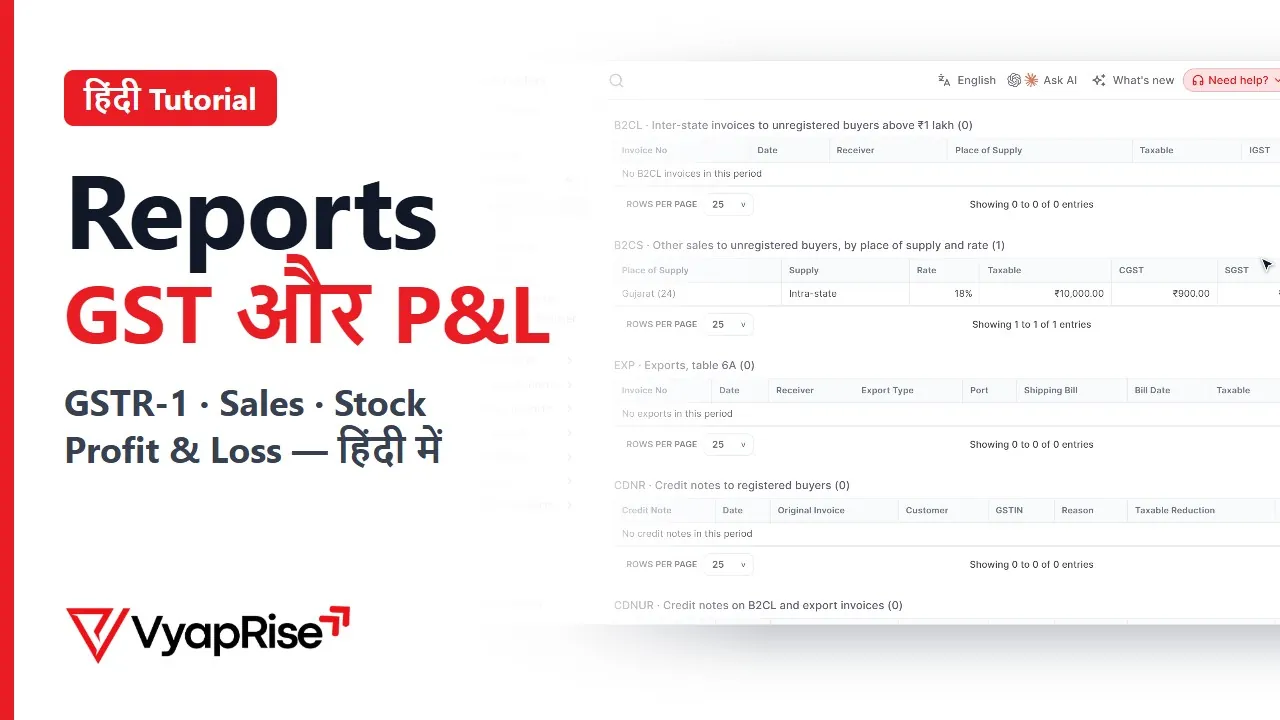
Reports — GSTR-1, GST due dates, Profit & Loss · 1:40
How VyapRise handles this
Find the missing ITC
Upload the GSTR-2B JSON from the GST portal and VyapRise matches it against your purchase bills: matched, missing from 2B, missing from your books, and amounts that differ. So you know which suppliers to call before the October return. GSTR-2B reconciliation and purchase bills are on the Pro plan.
Credit notes and amendments in the right month
A credit note is made from the original invoice and goes into the GSTR-1 credit note table. Once a month is marked as filed, a later change to one of its invoices is reported as an amendment (B2BA, CDNRA) in the month of the change. Credit notes and GST reports are on the Pro plan; filing is done on the GST portal.
Frequently asked questions
What is the last date to claim ITC for FY 2025-26?
30 November 2026, or the date you file the annual return (GSTR-9) for 2025-26 if you file it before that. The credit has to be taken in a GSTR-3B filed on or before that date. This comes from section 16(4) of the CGST Act.
Can I claim FY 2025-26 ITC in the November 2026 GSTR-3B?
No. The November return is filed in December 2026, after the 30 November cut-off. For a monthly filer the last return that can carry FY 2025-26 credit is the October 2026 GSTR-3B, and it must actually be filed by 30 November, not just be due before it.
I file quarterly under QRMP. Which return is my last chance?
Quarterly filers take ITC only in the quarterly GSTR-3B. The July–September 2026 return was due on 22 or 24 October; if you have not filed it yet, file it by 30 November 2026 with all your pending FY 2025-26 credit (late fee applies). The October–December return is filed in January 2027, after the cut-off, so it cannot carry FY 2025-26 credit.
What is the time limit for a credit note under GST?
A credit note for a supply made in FY 2025-26 must be declared in a return by 30 November 2026, or the annual return date if earlier (section 34(2)). It belongs in the return for the month in which it is issued, so in practice a FY 2025-26 credit note should be dated October 2026 and reported in the October GSTR-1. After the cut-off it can still settle the account with the buyer, but it does not reduce your GST.
Does filing GSTR-9 early shorten the deadline?
Yes. The law says 30 November or the date of filing the annual return, whichever is earlier. If you file the 2025-26 GSTR-9 on 15 November, you cannot take more FY 2025-26 credit or correct that year's returns after 15 November. Finish the clean-up first; GSTR-9 for 2025-26 is due by 31 December 2026.
What happens to ITC I miss by 30 November?
The law does not allow it to be taken in a later return, so the GST you paid on those purchases becomes a cost to the business. That is why the October reconciliation matters more than any other month's.